
What is addressing mode?
Addressing mode is a way that tells the CPU how to choose or access the operand (data) for an instruction in computer architecture. It gives the CPU directions on where to find the data.
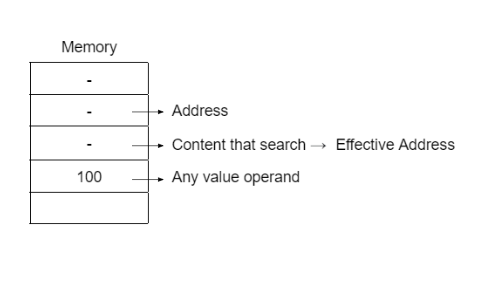
Program Counter
- Program Counter (PC) = Next Instruction.
- It keeps track of which instruction the computer will execute next.
Categories of addressing mode?
The most well known addressing mode are:
- Implied Addressing Mode
- Immediate Addressing Mode
- Register Addressing Mode
- Register Indirect Addressing Mode
- Auto-increment or Auto-decrement Addressing Mode
- Direct Addressing Mode · Indirect Addressing Mode
- Displacement Address Addressing Mode
- Relative Addressing Mode · Index Addressing Mode
Example problem
Find out the effective address of operand and operand value by considering different addressing modes.
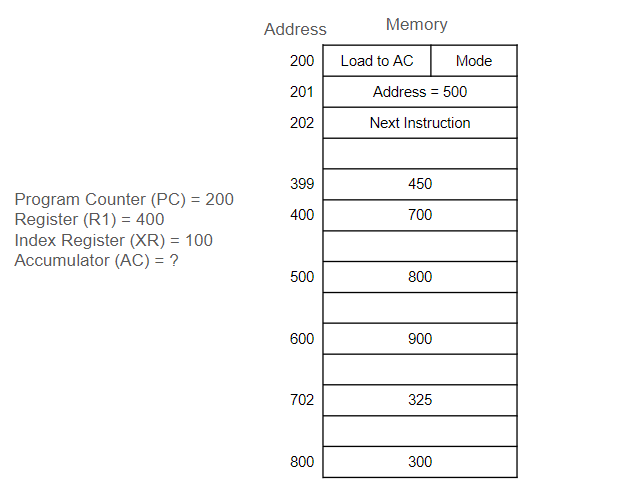
The solution is presented in a table format to show how different addressing modes determine the effective address and operand value.
| Addressing Mode | Effective Address | Operand | Notes |
|---|---|---|---|
| Immediate Addressing Mode | 201 | 500 |
|
| Register Addressing Mode | - | 400 |
|
| Register Indirect Addressing Mode | 400 | 700 |
|
| Direct Addressing Mode | 500 | 800 |
|
| Indirect Addressing Mode | 800 | 300 |
|
| Relative Addressing Mode | 702 | 325 |
|
| Index Addressing Mode | 600 | 900 |
|
| Auto-increment Addressing Mode | 400 | 700 |
|
| Auto-decrement Addressing Mode | 399 | 450 |
|